
Tree trimming and pruning is what Fort Myers Tree Removal Pros does most weeks of the year in Fort Myers, FL, and in the surrounding cities we cover including North Fort Myers, Cypress Lake, Cape Coral, Florida Gulf Coast University and Lehigh Acres. Twenty-plus years on this coast covers clearance work over roofs and drives, structural pruning on young and mature hardwoods, palm work, and the storm-season reduction that gets booked long before a storm.
The reason a trimming page here reads differently from one written anywhere else is that this canopy never goes dormant. Advice to prune in the dormant season is reproduced all over this market, including on pages that rank for it and at least one Florida county government’s own hurricane guidance, and it describes a tree that does not grow here. Bald cypress and royal poinciana are the two that genuinely go bare; the rest keep working through January.
So the timing conversation on our estimates is about flowering, fruiting, storm season and the tree’s reserves, not about leaf drop. Every cut is made to a published standard, nothing is topped or hat racked whatever it is called when it is asked for, and the objective is written down before anyone puts a saw in the canopy.
Pruning to a Published Standard
What the A300 Standard Actually Governs
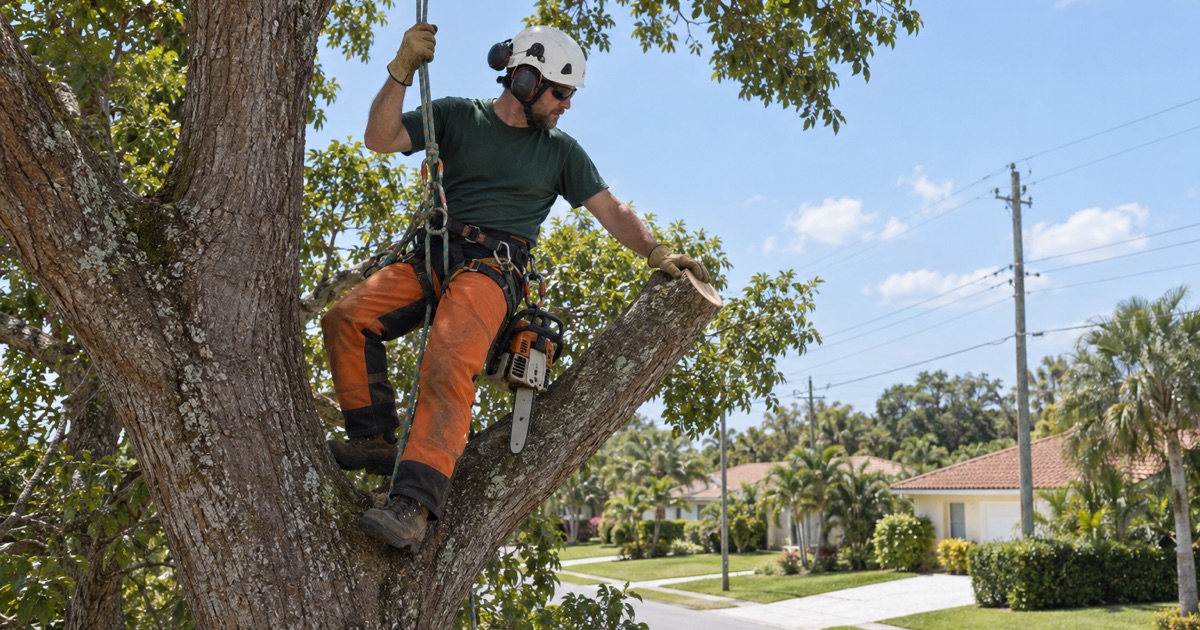
ANSI A300 is the industry’s written standard for tree care operations, and it matters because it turns a vague instruction into a specification: which objective the pruning serves, which class of cut is being made, and where the cut lands relative to the branch collar. Our scopes name the objective before the visit, so what you are buying is a defined piece of work rather than a morning of somebody’s judgment.
Reduction and Directional Cuts
A reduction cut shortens a limb back to a lateral large enough to take over as the new terminal, which is what allows a tree to seal the wound and keep a natural form. Directional pruning does the same thing to steer growth away from a roof, a drive or a conductor. Both take longer than a heading cut and both are the reason the result still looks like a tree afterward.
Safety Standard, and Cuts We Do Not Make
ANSI Z133 is the safety side of the same body of practice, and it governs how the crew works around conductors, on ropes and under load. On the cutting side the refusals are simple and absolute: no topping, no hat racking, no lion’s tailing that strips interior growth and leaves weight on the ends, and no spurs on a tree that is staying, which the city’s own site clearing specification also prohibits.
Trimming a Canopy With No Dormant Season
The Dormancy Error, and Where It Comes From
The advice travels because it is true somewhere else. It shows up here on ranking service pages, in national blog content carrying both answers in consecutive sentences, and on a Florida county’s public hurricane page telling residents to prune during the species dormant season. Acting on it in this market means waiting for a window that never opens, or cutting hard in the name of a dormancy the tree does not have.
Timing by Flowering and Fruiting Instead
What does drive timing here is the tree’s own calendar. Prune a flowering species at the wrong point and you remove next season’s display; prune a heavy fruiter before drop and you save a cleanup. We schedule around those, around nesting where it applies, and around the wet season when saturated ground makes equipment access a separate problem.
Storm-Season Reduction, Booked Early
The work that genuinely reduces storm risk is weight reduction on over-extended leads, removal of dead and hanging material, and attention to weak unions, and all of it takes a properly scheduled visit. We sell it in the calm months, because nobody climbs or flies a lift in a hundred-knot wind and a pruning crew booked during a watch is selling a promise it cannot keep.
Structural Pruning on Young and Mature Trees
Co-Dominant Stems and Included Bark
Where two stems of similar diameter meet, bark can become trapped in the union instead of wood knitting across it, and the join stays weak no matter how healthy the tree looks. Caught on a young tree, subordinating one stem is a few minutes of work. Caught at thirty years over a bedroom, the options narrow to a support cable or a removal, which is the whole argument for early structural pruning.
Shortening Long Horizontal Leads
Mature spreading hardwoods here carry long lateral limbs that shed on still, hot afternoons with no storm involved. Reducing the end weight on those leads, rather than cutting them off at the trunk, keeps the limb and lowers the lever arm. It is the single most useful piece of preventive pruning on an established laurel oak on this coast.
Clearance From Roofs, Drives and Structures
Clearance work has a defined target, and writing it down stops it drifting into a general thinning. We set the distance from the roof plane, the drive or the walkway, prune to reach it with reduction cuts, and leave the interior canopy alone. Stripping the inside of a canopy to create visible clearance is how a tree ends up with all its weight on the tips.
Commercial, Association and Community Trimming
Associations and Common Elements
On association ground the tree is a shared asset and the decision has to survive a board meeting, so the documentation is part of the deliverable. We scope by tree rather than by lot, state the objective for each, and hand back a dated record with photographs. That record is the reason a manager can answer a resident six months later without reconstructing anything.
Manufactured Home Communities and Park Boards
This service area holds tens of thousands of manufactured homes, and a rented lot raises a question a fee-simple yard does not: who authorizes the work and who is billed for it. We work with park management and boards on scheduled canopy maintenance across a community, which is a different piece of work from one call about one tree and prices differently.
Commercial Sites Outside the State Preemption
The statutory route that frees a single-family homeowner from local tree permitting does not reach commercial parcels, vacant land, attached dwellings or required landscape material, so a commercial trimming scope has to be read against the local code first. We name which jurisdiction the property sits under and what it requires before the crew is scheduled, rather than after a stop-work conversation.
- 20+ Years on This Coast
- Written Condition Reports
- Four Counties Covered