Invasive and exotic tree removal is steady work for Fort Myers Tree Removal Pros across Fort Myers, FL and the surrounding cities we serve, among them North Fort Myers, Cypress Lake, Cape Coral, Florida Gulf Coast University and Lehigh Acres. Twenty-plus years in this region means most overgrown parcels we walk have at least one of four species on them, and usually more than one.
The thing that separates this from ordinary removal is that the job is not finished when the tree is on the ground. Several of these species return from a cut stump, from roots, or from a seed bank that was in the soil before anyone started, and a scope that ignores that is a scope that buys one clear season. We say which species is present and what the follow-up looks like at the estimate.
The second difference is regulatory, and it runs in the property owner’s favor for once. Local tree codes here protect native and listed species and generally do not extend that protection to recognized invasives, so removal frequently falls outside the permit trigger entirely. Confirming that for your jurisdiction is part of the quote rather than an assumption inside it.
The Four That Dominate Cleared Ground Here
Brazilian Pepper
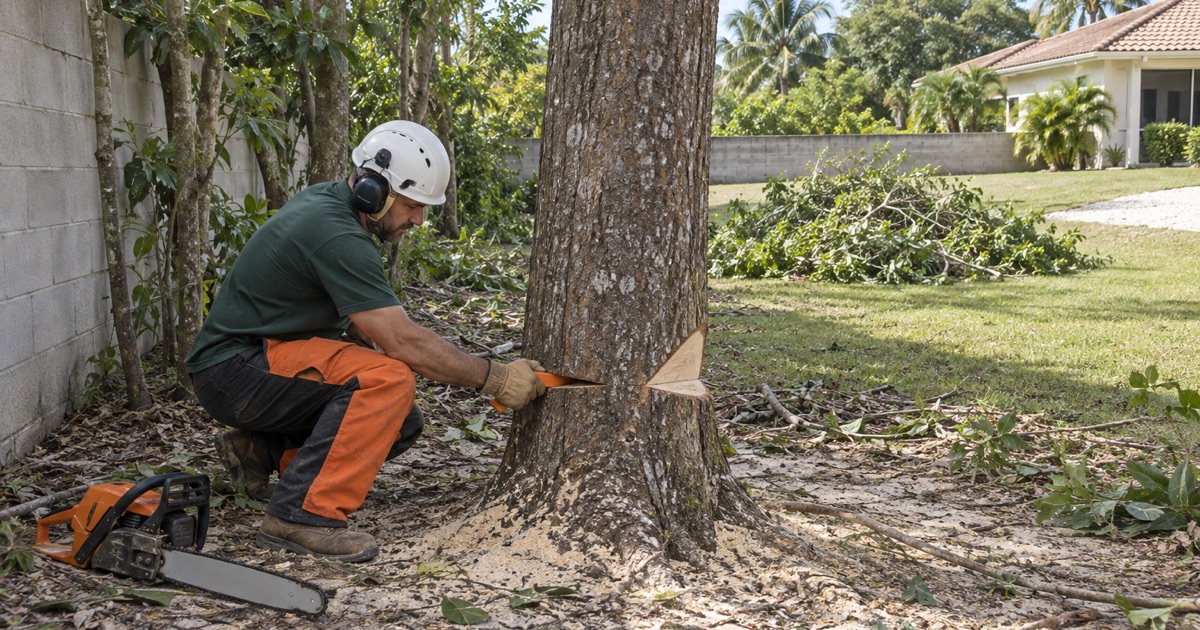
The most common invasive we encounter, and the one that most reliably defeats an incomplete removal. It forms dense multi-stemmed thickets that shade out everything underneath, spreads by bird-dispersed fruit, and resprouts hard from cut stumps and roots. A stand cut flush and left comes back as more stems than it had, which is why the stump work is part of the quote and not an option beside it.
Melaleuca and Australian Pine
Melaleuca carries a papery bark and releases seed in enormous quantity when the tree is stressed, including by cutting, so the method and the timing of the work affect what happens afterward. Australian pine is not a pine at all but a casuarina with a shallow root plate that fails in wind, which makes a mature one beside a house a structural hazard quite apart from its status on any list.
Carrotwood and the Newer Arrivals
Carrotwood spreads by fruit into hammock edges and disturbed ground and is frequently planted as a landscape tree by people who have no idea what it is. It is the species most often on an estimate as a surprise, because the homeowner believes they are paying to remove an ornamental. Identification on the walk-through is what turns that into an informed decision.
Why Cutting Is Not Removing
Resprouting From a Cut Stump
The root system of an established invasive holds enough stored energy to rebuild a canopy, and on several of these species a flush cut is effectively a hard pruning. Grinding the stump, treating it, or excavating it are the three real answers, and which one applies depends on the species, on what is around it and on whether anything is going to be built there.
Seed Banks and the Second Season
Even a complete removal leaves whatever is already in the soil, and on a parcel that has carried Brazilian pepper or carrotwood for years that is a considerable quantity. The realistic scope is an initial clearing and a follow-up pass, and we would rather price both at the outset than have the parcel look like a failure twelve months later.
Treatment Is Licensed Work, Cutting Is Not
The inversion in this trade is worth stating on this page specifically. Florida licenses nobody to cut a tree down, but applying any substance to one is pest control under Chapter 482, which defines an ornamental to include a tree and carries no exemption for arborists or landscapers. Cut-stump treatment therefore sits in a different regulatory category from the removal it follows.
Permits, Mitigation and What Counts as Protected
Exotics and the Local Tree Codes
Protection in the local codes here attaches to native and listed species rather than to trees in general, and in one county the mechanism is a positive approved tree list, which by its nature excludes the invasives. That usually means no permit for their removal, but the trigger is written differently in every jurisdiction on this map, so it is checked rather than presumed.
Mitigation Credit and Replanting
Where a site has a landscape or tree requirement to satisfy, retained natives typically count toward it and invasives do not, which changes the economics of what to keep. Knowing that before the plan is set can mean designing around a mature live oak or slash pine that would otherwise have been cleared with everything else.
Shoreline and Preserve Edges
Where an invasive stand runs to the water or abuts a preserve, the last few feet are governed differently from the rest of the parcel. Mangroves in particular sit outside the state tree preemption under their own statute, so a clearing scope that reaches the shoreline needs that boundary drawn explicitly. We mark it on the walk-through before anything is quoted.
- 20+ Years on This Coast
- Written Condition Reports
- Four Counties Covered