
Crane-assisted tree removal is the method Fort Myers Tree Removal Pros reaches for when the ground under a tree is already occupied, and after twenty-plus years working Fort Myers, FL and the surrounding cities on our map, including North Fort Myers, Cypress Lake, Cape Coral, Florida Gulf Coast University and Lehigh Acres, that describes a large share of the properties here.
The local pattern is specific. Screen pool enclosures, tile roofs, paver decks, seawalls and canal banks fill the exact space a conventional removal needs for a drop zone, and several of them are more expensive to repair than the removal itself costs. A crane converts the problem from rigging pieces down through an obstacle course into lifting them out over the top.
What this page is not is a claim that a crane is always right. It is a set-up dependent method with real constraints: bearing ground, an unobstructed swing, and overhead conductors that dictate everything. We scope the position, the reach and the path on the estimate visit, and we say plainly when a spider lift or an ordinary climb is the better answer.
When the Crane Is the Cheaper Decision
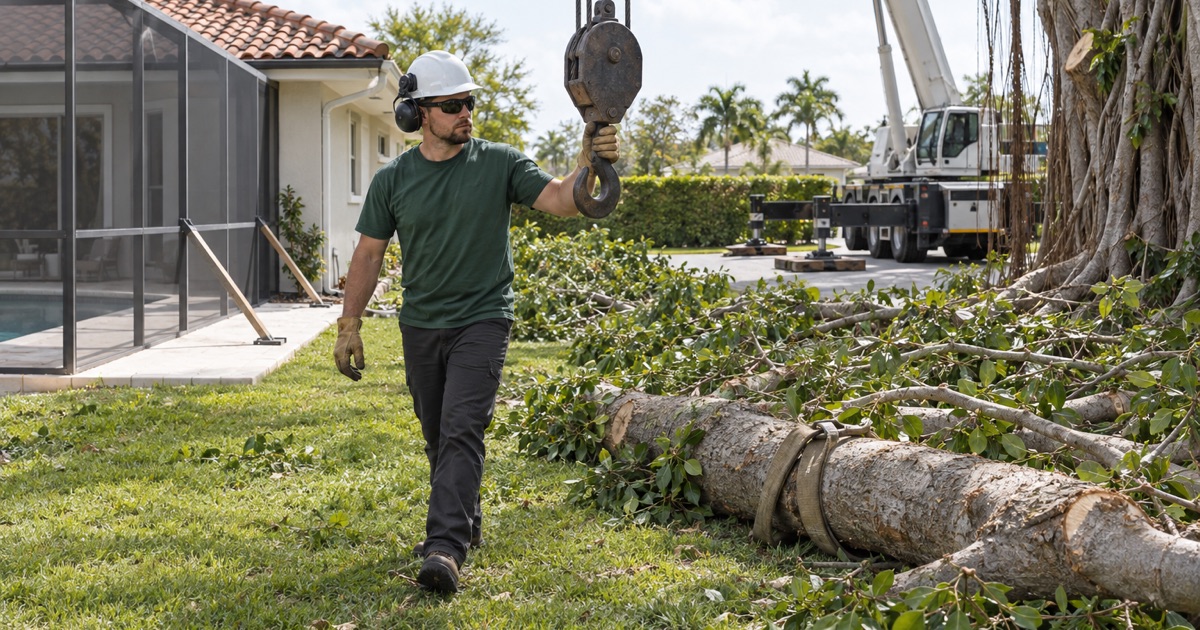
Screen Enclosures, Tile Roofs and Pavers
A screen pool cage is one of the most commonly damaged structures on this coast and one of the least reliably covered by a policy, with at least one major form here covering it not at all. A tile roof is expensive to repair for one broken tile. Where the entire drop zone is made of those, lifting sections out over them is the method that keeps the job from turning into two claims.
Dead and Decayed Trees Nobody Should Climb
A crane’s second use is to keep people out of a tree that cannot be trusted to hold them. A stem with advanced decay at the buttress, a storm-damaged trunk with a split union, or a long-dead hardwood are all structures whose remaining strength is unknown. Working them from a boom or setting a line from the crane removes the question rather than betting on it.
Seawalls, Canal Banks and Dock Access
On a canal lot the tree is frequently between the house and the water with no route in either direction, and the seawall cap is exactly what nobody can afford to drop a trunk section onto. A crane set in the drive can pick over the roof and place sections at the truck, and it does it without tracking equipment across saturated ground next to a bank.
What the Set-Up Actually Requires
Where the Machine Stands and What It Reaches
Capacity falls as the boom extends, so the honest question is never whether the crane can lift the tree but what it can lift at the radius the set-up allows. That is why the position is chosen first and the pick plan second. We identify the stand, the radius to the tree and the radius to the landing area on the estimate rather than discovering the geometry on the morning.
Ground Bearing, Saturated Soil and Mats
Outrigger loads are concentrated into a small footprint, and the ground here is sand with a water table close to the surface for months of the year. Mats or cribbing spread that load, and the size of them is a function of the machine and of what is underneath: a paver drive, a thin slab, a septic tank or a drain field each change the answer.
Overhead Conductors and the Swing Path
Everything else is subordinate to the wires. A boom and a suspended load have to keep a defined distance from an energized conductor through the entire arc, loaded and after release, and the tree’s own limbs can hide a service drop until the crew is under it. Where the geometry does not work, the choice is a different position, utility coordination, or a different method.
The Honest Comparison With Other Methods
Spider Lifts and Grapple Saw Trucks
A tracked spider lift walks through a gate a crane cannot approach, sets up on a pool deck with the right protection, and puts a climber safely outside a compromised tree. A grapple saw truck cuts and carries from the boom with nobody in the canopy at all, which suits roadside and storm work. Both are often the right answer on a lot where a crane simply cannot stand.
When a Climb Is Still the Right Call
A sound tree with a genuine drop zone, a rear yard no machine can reach, and a removal that is really a large pruning job are all climbing work, and pretending otherwise inflates a quote for nothing. The method follows the property and the condition of the tree, and we would rather explain why the cheaper option is the correct one than sell the machine.
- 20+ Years on This Coast
- Written Condition Reports
- Four Counties Covered