
Mangrove trimming sits at the edge of what Fort Myers Tree Removal Pros does, geographically and legally, across Fort Myers, FL and the surrounding waterfront communities on our map including North Fort Myers, Cypress Lake, Cape Coral, Florida Gulf Coast University and Lehigh Acres. Twenty-plus years on this coast has taught us that the first question on a shoreline is never how, it is who has authority over it.
The reason this page exists is that almost nobody in this market carries one. Mangroves are treated as an afterthought on a general tree service site, or worse, as ordinary vegetation, and the two assumptions behind that are both wrong. They are protected by their own statute, and the permitting authority for them is usually not your county.
So what follows is what the law actually says, what the exemption genuinely covers, who holds authority where, and what the work involves. We also say plainly what we do not hold, because this is a trade where seven operators in this ring print the word licensed and exactly one publishes an identifier anybody could check.
Mangroves Have Their Own Statute
Written Out of the State Tree Preemption Deliberately
Florida’s tree preemption is the widest opening in state tree law for a homeowner, and mangroves are excluded from it on purpose. That means the documentation route that removes local permitting for a hazardous tree on a single-family lot has no application at the water’s edge. The same parcel can be governed by two entirely separate legal regimes forty feet apart.
What the Act Covers and What the Exemption Allows
The Mangrove Trimming and Preservation Act runs at sections 403.9321 through 403.9333 and protects white, red and black mangrove by name. The exempt trimming a riparian owner may do is dimensionally bounded: it applies to a fringe whose pre-trimmed height is ten feet or less, and it does not permit cutting below six feet. Those two numbers decide most residential questions.
The Professional Mangrove Trimmer Program
The act establishes a professional mangrove trimmer designation, which is a real registered credential rather than a marketing phrase, and certain categories of work require one. We describe it here as a fact about the trade because it is one, and we tell a customer when the job in front of them calls for it rather than quoting past the question.
Who Actually Has Authority on Your Shoreline
Delegated Local Governments in This Ring
The state department of environmental protection holds primary regulatory and permitting authority over mangrove trimming, augmentation and removal statewide, and delegates it to specific local governments that have applied for it. In this service area only the City of Sanibel holds that delegation, which makes a Sanibel waterfront a materially different permitting conversation from one a few miles away.
Where the State Holds It Directly
Everywhere in this ring that is not a delegated local government, the state is the authority, and that includes places people assume would run their own program. Neither Charlotte County nor the City of Punta Gorda appears on the published delegation list, and one city in this area disclaims mangrove authority in its own published words. County lines are not the boundary that matters here.
What Not Being Delegated Actually Means
It means the local permit counter cannot answer your question, and that a local approval for something else on the property does not authorize shoreline work. It also means the timeline is the state’s rather than the county’s. Establishing which office governs the address is the first line of any scope we write for waterfront vegetation, before species, method or price.
Species, Method and the Work Itself
Red, Black and White Mangrove
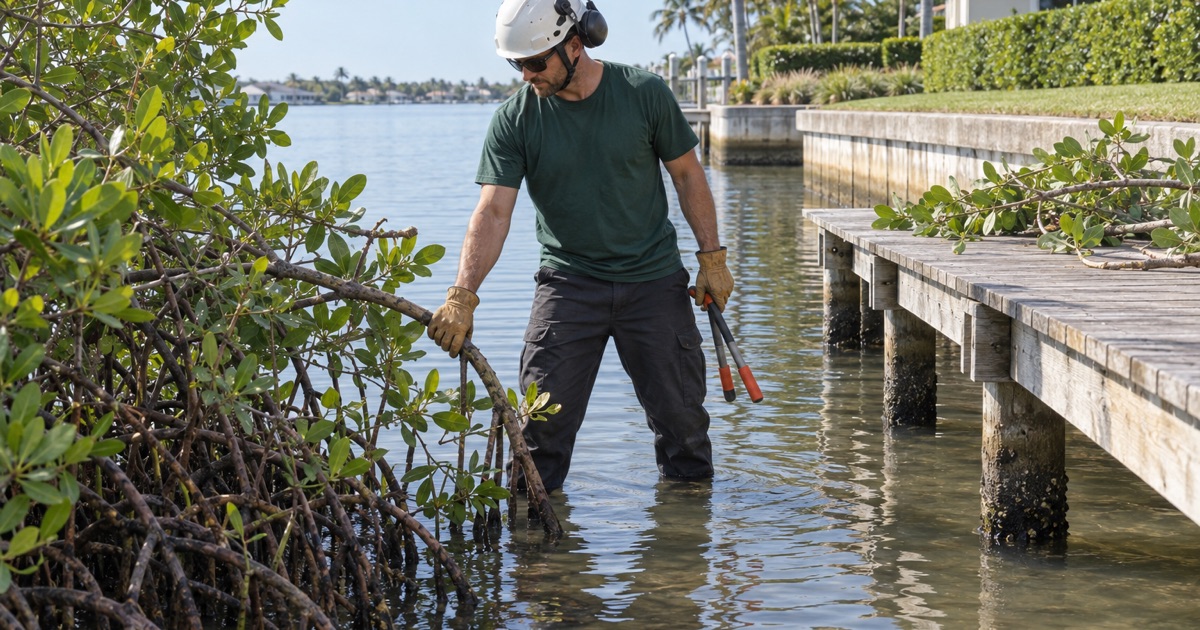
The three protected species occupy different positions relative to the water and are distinguishable once you know what to look for: red mangrove on prop roots at the waterline, black mangrove behind it with pneumatophores standing out of the mud, white mangrove further up the slope. Which ones are in the fringe affects the access, the footing and how a stand responds to trimming.
Trimming for a View Without Killing the Stand
A fringe maintained at a permitted height on a regular cycle stays dense, keeps holding the shoreline and keeps the view open. The same fringe cut hard once, then left, thins out and dies back in patches, which costs the property both the screen and the bank stabilization. The economics favor the cycle, and the statute is written around the same idea.
Dead Material, Storm Damage and Access
After a storm the useful distinction is between genuinely dead stems, defoliated growth that will recover, and material creating a real access or navigation hazard. Getting to any of it is its own problem on a soft shoreline with prop roots underfoot, which is why the access plan is part of the estimate rather than something discovered on the morning of the work.
- 20+ Years on This Coast
- Written Condition Reports
- Four Counties Covered