
Shrub, hedge and brush removal rounds out what Fort Myers Tree Removal Pros does across Fort Myers, FL and the surrounding cities we work in, including North Fort Myers, Cypress Lake, Cape Coral, Florida Gulf Coast University and Lehigh Acres. It covers scheduled hedge maintenance, hard renovation cuts, taking shrubs out root and all, and pulling an overgrown lot back to something you can walk across.
The local condition that shapes all of it is that growth here barely stops. A hedge cut twice a year in a market with a real winter is cut four or five times here to hold the same height, and the arithmetic of that is usually in the homeowner’s favor rather than against it. Frequent light cuts keep a dense shell; two hard cuts a year produce a hedge that climbs and thins.
We also separate the cutting from the hauling on every estimate, because clippings are bulkier than anyone expects and the disposal rules are stricter than anyone expects. The city allows ten cubic yards of yard waste a week and charges beyond it, and a pile that misses the size rule is a fee that lands on the property owner.
What Actually Decides the Price
Face Area and the Number of Sides
A hedge quote is built from how much face is being cut rather than how long the run is. Two sides and a top is three times one face, a hedge against a wall is one face, and a freestanding screen is three. Height moves it again, because anything over reach means a platform or a lift and a different crew configuration on the day.
Frequency Beats Severity
A hedge held at a set height by light, regular cuts keeps an even outer shell of foliage and stays where you put it. The same hedge cut hard twice a year gains height each cycle, because each cut leaves stubs slightly beyond the last, and the interior goes bare from shading. Over twelve months the frequent schedule is usually the cheaper one as well as the better-looking one.
Where the Clippings Go
A heavy cut on a long run produces far more volume than the trimmed result suggests, and that volume has to go somewhere. On site as chip, out to a horticultural waste facility at the county gate rate, or into the weekly collection within the size limits: three routes with three prices. We put it on its own line so the choice is yours rather than assumed.
Species That Behave Differently Here
Ficus Hedges and the Roots Under Them
The ubiquitous privacy hedge in this market is a large tree kept small by regular cutting, and its root system is sized for the tree rather than the hedge. That is fine in an open bed and a real problem within a few feet of a driveway, a pool deck or a seawall. Where the planting is close to something structural, the roots are a separate conversation from the trimming.
Clusia, Podocarpus and Areca Clumps
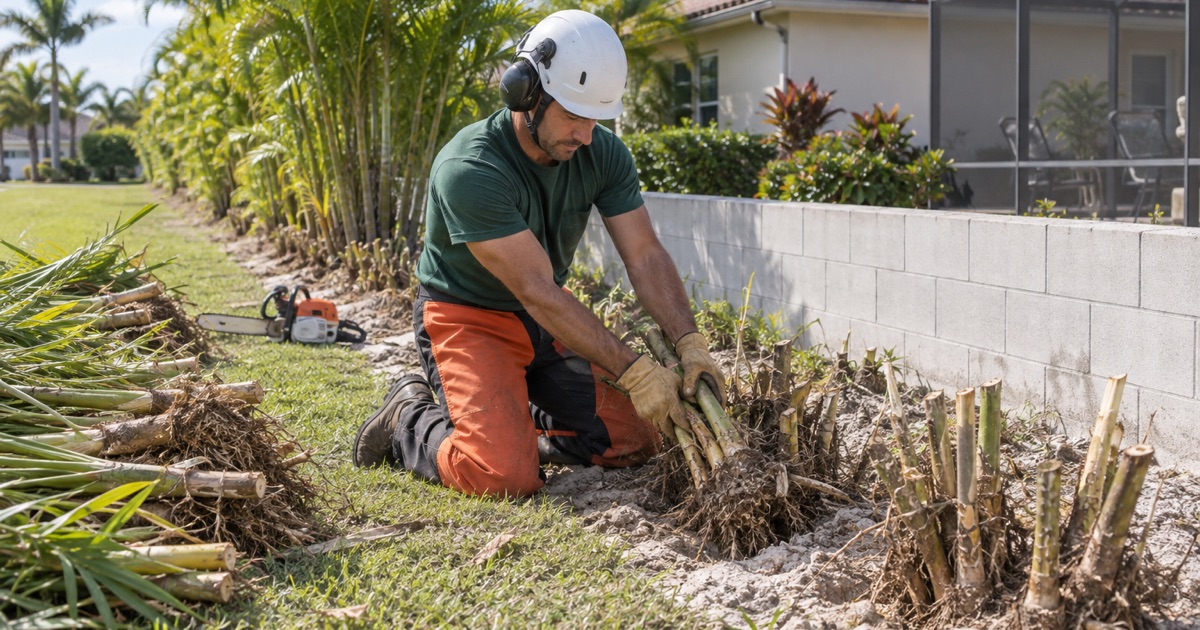
Clusia holds a thick leathery shell and tolerates a hard cut better than most; podocarpus takes a fine, formal shape and responds badly to being sheared out of it; areca is a clumping palm and is thinned by removing whole canes at the base rather than by cutting the tops off, which is the single most common mistake made on it. The species decides the method.
Invasive Brush: Brazilian Pepper and Carrotwood
On neglected ground the shrub layer is frequently not a planting at all. Brazilian pepper and carrotwood both establish freely here, both resprout from cut stumps, and both return within a season if the clearing is only a cut. Identifying them changes the scope from a trim into a removal with follow-up, and we would rather say that at the estimate.
Brush, Overgrowth and a Neglected Lot
Taking Back an Overgrown Parcel
Cutting the understory, reducing volunteer shrubs and opening sightlines is usually a different act from clearing a lot, and the local permit triggers generally attach to trees and to development rather than to brush. Where protected trees are standing in the middle of it, the scope changes, so the walk-through establishes what is a shrub, what is a young tree and which code reaches it.
Code Enforcement, Height Limits and Sightlines
The city requires weeds, grass and underbrush to be kept to no more than twelve inches on all property, which turns a rough lot into an enforcement matter faster than most owners expect. Corner sightlines and overhanging growth across a sidewalk are the other two that generate letters. Scoping the maintenance cut alongside the first clearing is what keeps it from recurring.
- 20+ Years on This Coast
- Written Condition Reports
- Four Counties Covered