Tree Removal in Fort Myers, Quoted Straight

Twenty-plus years on this coast, four counties of permit rules, and a written condition report before anything comes down.

Fort Myers Tree Removal Pros has spent twenty-plus years taking trees and palms down, cutting them back and grinding their stumps out across Fort Myers and the four counties this coast is divided into. We handle hazardous removals, arborist condition reports, stump grinding, tree trimming and pruning, palm work, land and lot clearing, storm damage, hedge and brush removal, crane picks, tree disease questions, property line work, invasive removal and mangrove trimming. Every one of those jobs starts with somebody standing at the base of the tree.

The service map crosses Lee, Charlotte, Collier and Hendry counties, and those four jurisdictions do not write their tree rules in the same units. One counts points, one counts inches, one counts feet of clear trunk and one publishes no vegetation removal application at all. Before we quote a removal we tell you which regime your address sits under, because the permit answer changes the sequence of the job and sometimes changes whether the job should happen.

What we refuse is as much a part of the quote as what we sell. Topping, hat racking and hurricane cuts are declined on hardwoods and on palms however the job is asked for, hauling and disposal get their own line because the tipping gate changes price at every county line we cross, and we will tell you when a tree should stay and what pruning or a cable would cost instead.

Get Your Free Quote

Fast response • No obligation

So we can reach you about your request.

So we can send you a confirmation after you submit this inquiry form.

  • 20+ Years on This Coast
  • Written Condition Reports
  • Four Counties Covered

What we do

Our Services

Tree Removal and Arborist Work in Fort Myers, Florida

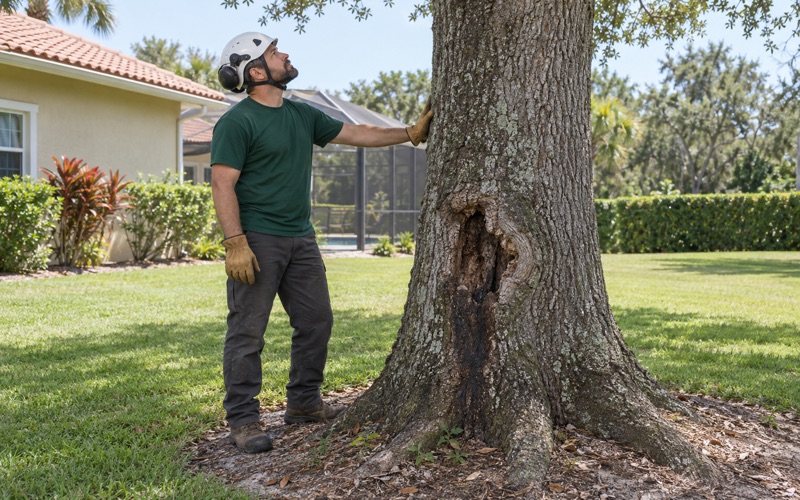
Worker reading a basal cavity in a laurel oak bole in a Fort Myers back yard.

Arborist

Tree risk assessment, written condition reports and section 163.045 documentation for Fort Myers homeowners and property managers.

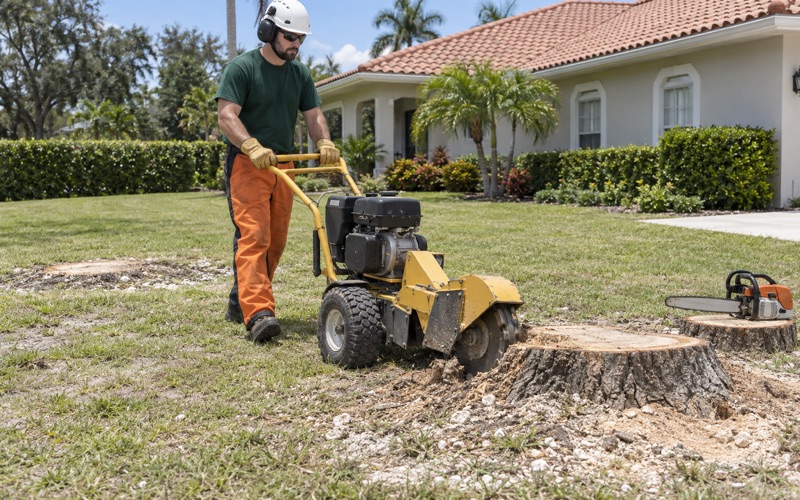
Worker walking a stump grinder by its tow bar toward a cut live oak stump on a Fort Myers lot.

Stump Grinding

Stump grinding and stump removal in Fort Myers, with depth, grindings, backfill and haul-away priced as separate lines.

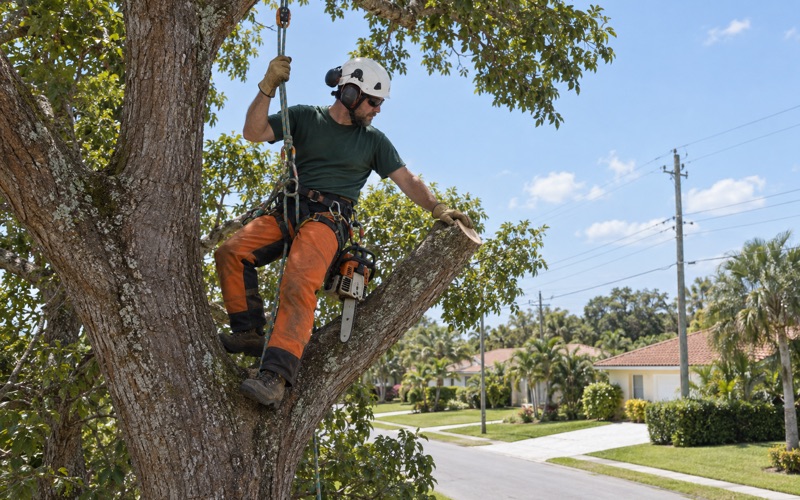
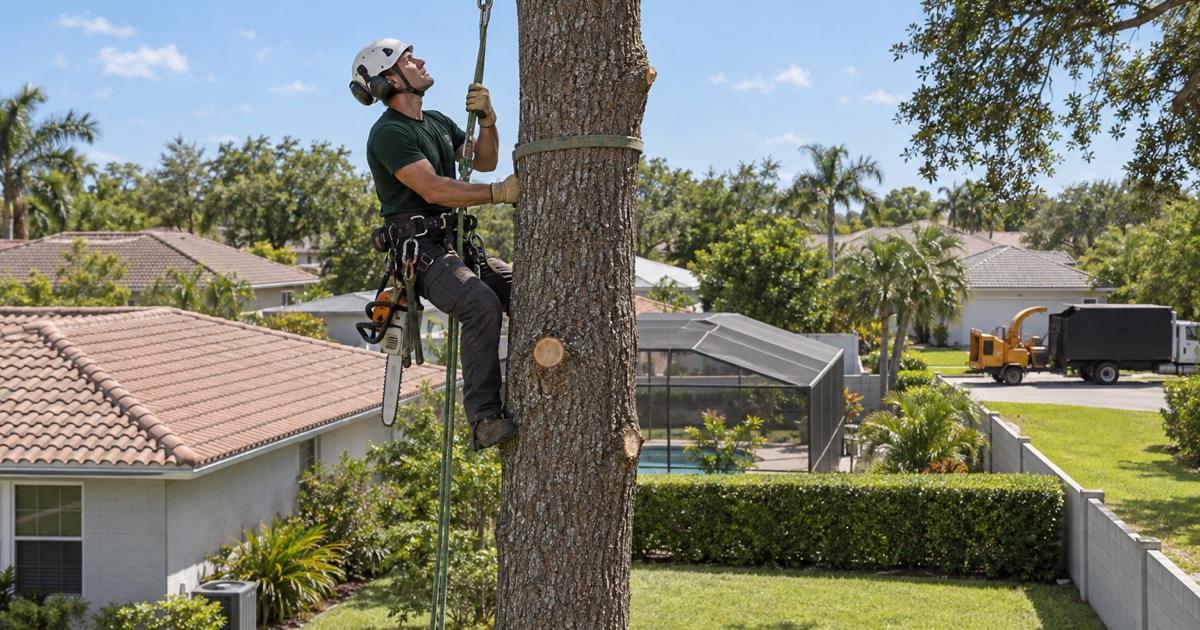
Climber on rope making a reduction cut at the branch collar of a mahogany limb over a Fort Myers street.

Tree Trimming

Tree trimming and pruning in Fort Myers, cut to the A300 standard, with clearance, structural and storm work priced separately.

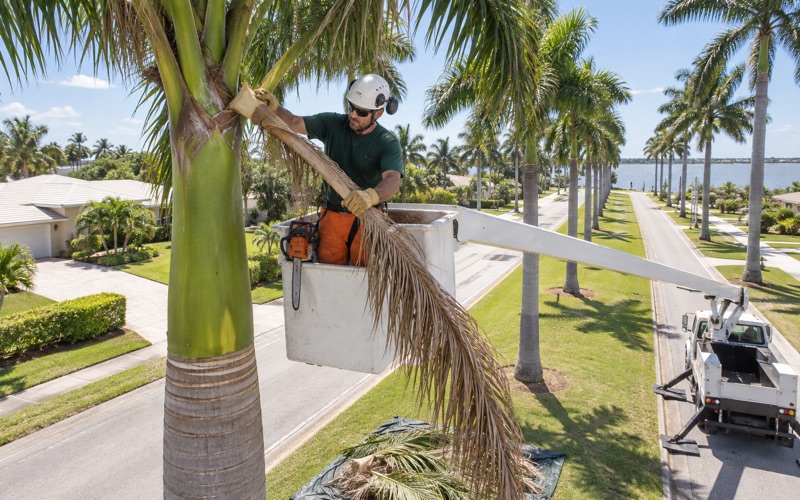
Worker in a bucket cutting a royal palm frond at its leaf base above a Fort Myers boulevard.

Palm Tree Trimming

Palm trimming and palm removal in Fort Myers, priced by species and access, with hurricane cuts and hat racking refused.

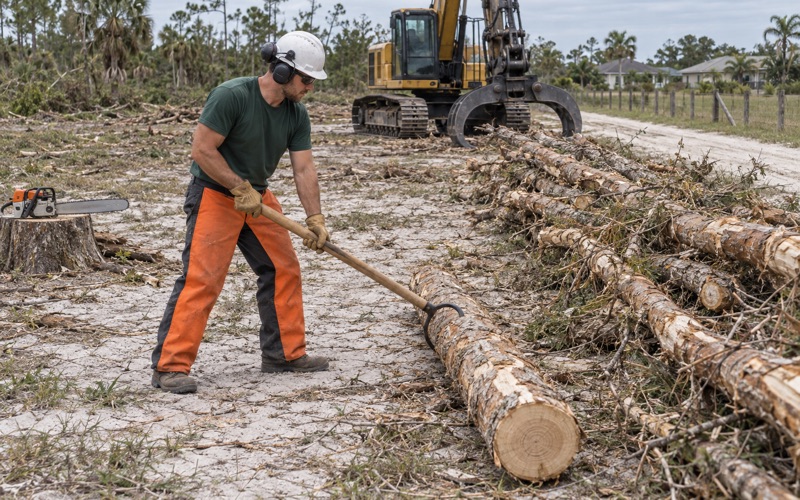
Worker rolling a cut melaleuca cull log onto a windrow with a cant hook on a Fort Myers clearing lot.

Land Clearing

Land and lot clearing across four counties, scoped against the code that applies and priced with grubbing and haul-away separated.

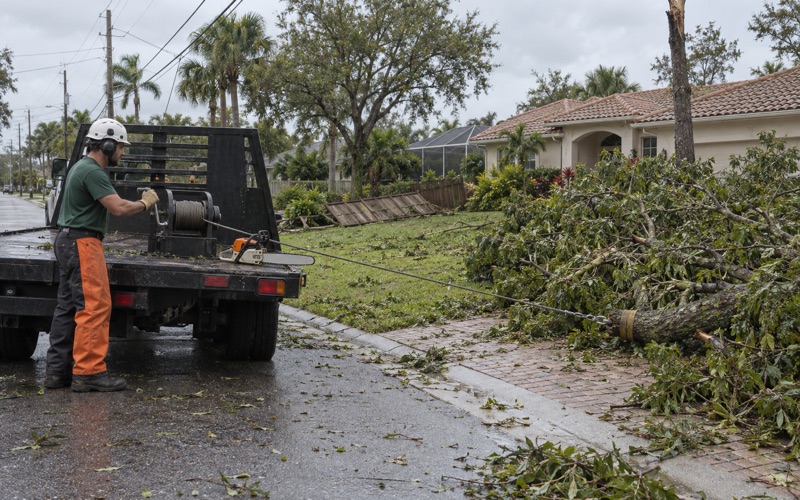
Worker at a truck winch drum drawing a storm-broken laurel oak top clear of a Fort Myers drive.

Emergency Tree Removal

Storm damage and emergency tree removal in Fort Myers, triaged by what the tree is on and what is still holding tension.

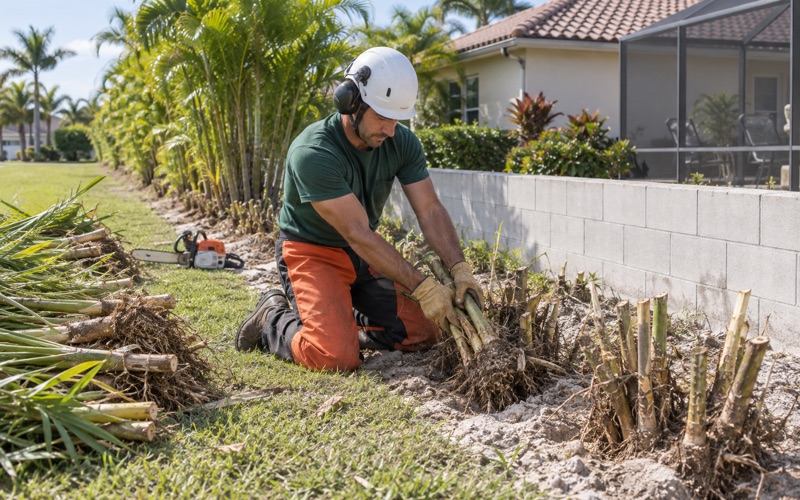
Worker gathering a cut areca palm stem cluster out of a Fort Myers boundary planting.

Hedge Trimming

Hedge trimming, shrub removal and overgrown brush clearing in Fort Myers, priced by face area, frequency and disposal.

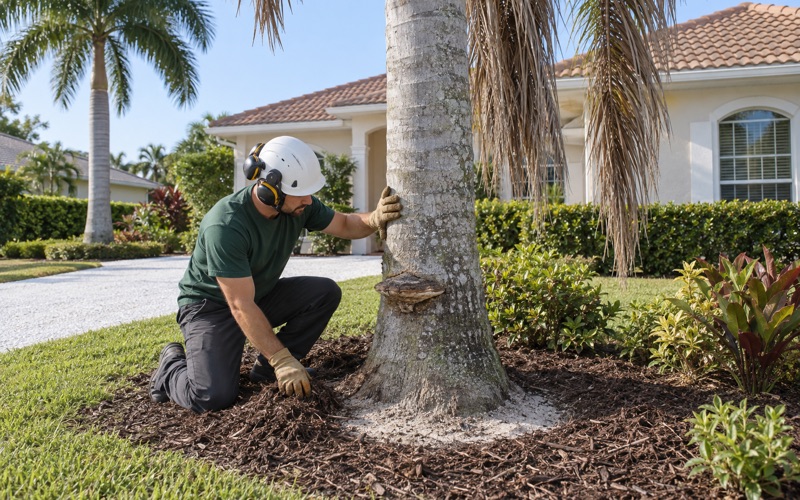
Worker examining a bracket conk low on a declining royal palm trunk in Fort Myers.

Tree Disease Treatment

Diagnosis and plant health care for declining trees and palms in Fort Myers, including the cases where nothing can be sold.

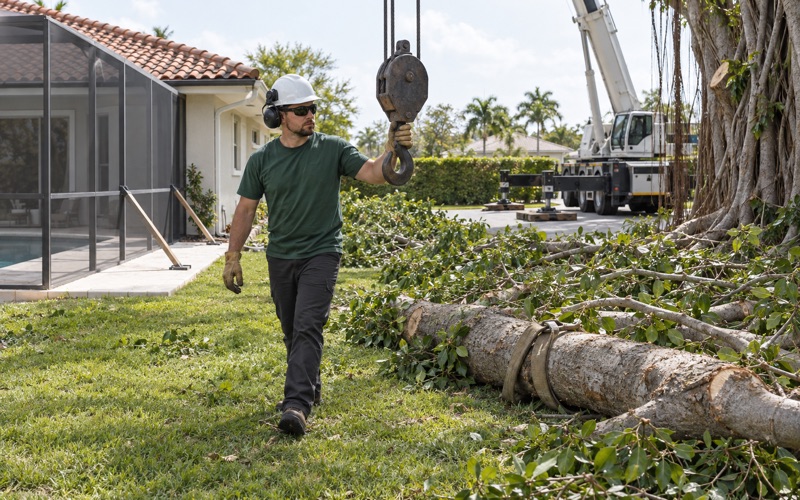
Worker walking an empty crane hook block out to the next banyan pick on a Fort Myers lot.

Crane Tree Removal

Crane-assisted tree removal in Fort Myers for trees over enclosures, tile roofs and seawalls where a climb is the wrong method.

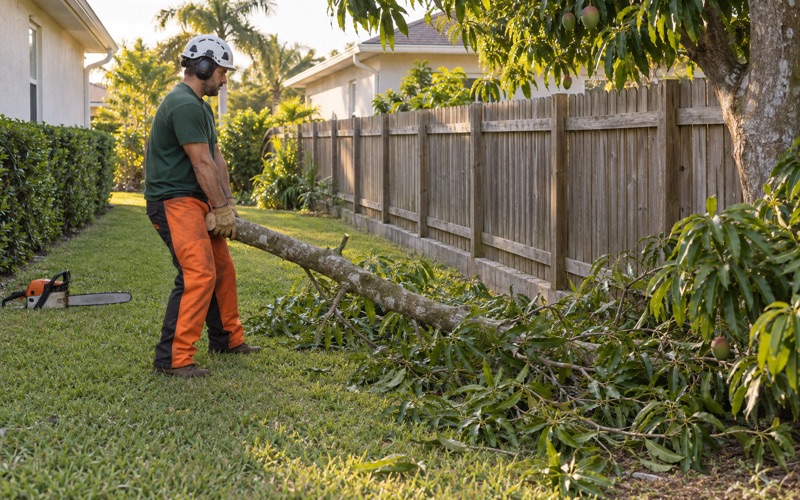
Worker lifting a severed mango limb butt back off a neighbor's turf at a Fort Myers boundary.

Property Line Tree

Property line and neighbor tree work in Fort Myers, documented in writing so both households read the same account.

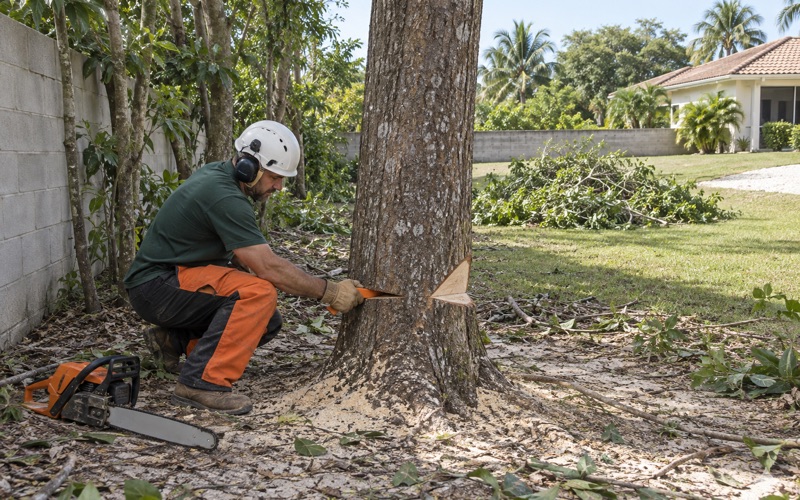
Worker seating a felling wedge in the back cut of a java plum at a Fort Myers rear boundary.

Invasive Tree Removal

Invasive and exotic tree removal in Fort Myers, scoped so the species does not simply come back the following season.

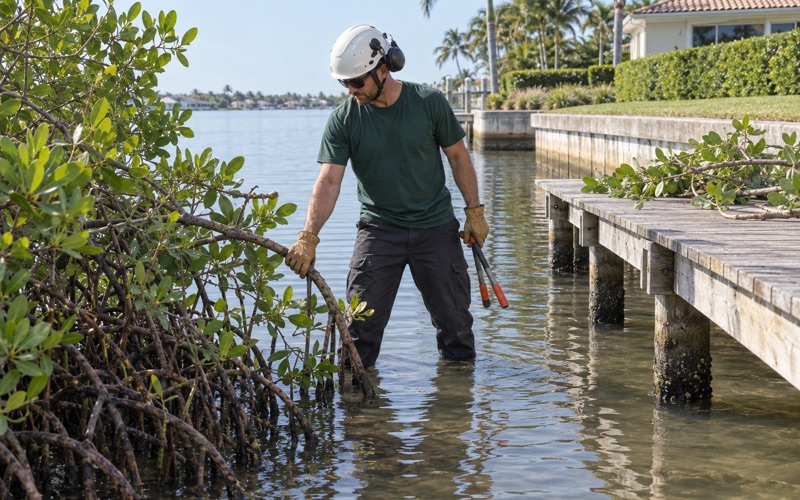
Worker steadying a red mangrove prop root while cutting back a low branch at a Fort Myers tidal shoreline.

Mangrove Trimming

Mangrove trimming on shorelines near Fort Myers, worked against the state act and whichever authority actually governs your waterfront.

What Twenty Years on This Coast Buys

Climber dressing a rigging sling on a laurel oak stem above a Fort Myers back yard.

Twenty-Plus Years of Removals in Southwest Florida

Every crew here has worked this ground through two named hurricanes and the slower failures that followed them, so the estimate is calibrated to saturated sand, an evergreen canopy and a water table sitting within a foot and a half of the surface for months, rather than to a textbook written for a market with a winter.

The Licensing Answer Nobody Gives You Straight

Florida issues no tree, arborist, land clearing or landscaping contractor license, and Florida Statutes section 163.211 preempts local occupational licensing of it. We say that plainly instead of printing the word licensed, because seven operators in this ring print it and exactly one publishes an identifier a customer could check.

A Dated Condition Report Before the Saw

No tree we recommend removing comes down before a dated written report describes what we found and why the recommendation follows from it, so the reasoning exists on paper before the equipment arrives rather than being reconstructed afterward from a phone call.

Why Choose Fort Myers Tree Removal Pros

Four Counties, Four Permit Answers

Every quote names the jurisdiction your parcel sits in before it names a price, because Lee, Charlotte, Collier and Hendry each answer the permit question differently, so a crew assuming one county’s rule holds next door starts work that has to stop rather than pricing the permit path the parcel actually requires.

Palms Quoted as Palms

No palm on our estimates is priced as a small tree. A palm has one growing point, no cambium and a trunk diameter fixed for life, so the work and the aftermath differ from a hardwood of the same height, rather than a royal turning into a crane job discovered on the morning of the work.

Hauling on Its Own Line

Every estimate separates cutting from hauling and disposal, because the horticultural waste gate rate changes at every county line this map crosses and one bundled number hides which half is the tree. You can question the gate, or keep the chips on site rather than paying to move them.

No Topping, No Hat Racking, No Hurricane Cuts

We refuse all three, on hardwoods and on palms, whatever the job is called when it is asked for. Topping leaves weakly attached regrowth on a compromised stem and a hurricane cut strips a palm of the reserves it needs, so the practice sold here as storm preparation makes failure likelier rather than preventing it.

Machines Matched to the Gate

Every job is scoped to the access it actually has, whether that means a thirty-five inch grinder walked down a side yard, a spider lift set on a pool deck or a crane pick over a screen cage. Width and cutting depth are not coupled on grinders, so we state the machine as configured rather than promising a depth it cannot reach.

A Straight Answer About Keeping the Tree

We will say when a tree should stay and put a number beside the pruning, root collar excavation or support cable that would replace the removal, because a company quoting only removals has one answer to every question rather than the cheapest good outcome this coast frequently allows.

Hurricanes, Storms and Emergency Tree Work

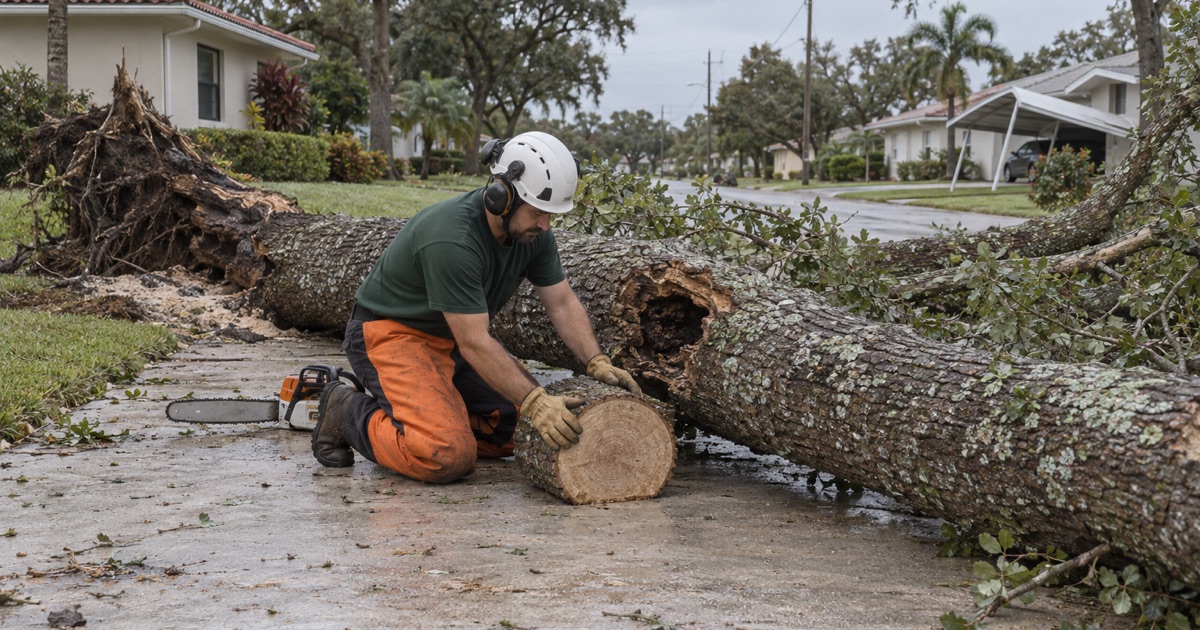
Worker setting a live oak log round as cribbing under a storm-failed stem across a Fort Myers drive.

What Charley Broke and What Ian Drowned

Charley in 2004 and Ian in 2022 struck this coast eighteen years apart and injured trees by two different mechanisms. Charley was overwhelmingly a wind event on the canopy; Ian pushed salt water up the Caloosahatchee and stood it in the street grid. We scope storm work by which of those happened at your address, not by the storm’s name.

Wind Damage and Salt Damage Are Different Jobs

Wind snaps stems and strips crowns, and the damage is visible the next morning. Storm surge salt inundation attacks the root plate, and nothing is visible the next morning at all. The National Hurricane Center recorded five to eight feet of inundation above ground level up the river in Fort Myers during Ian, which is a root-plate loading rather than a canopy one.

Delayed Post-Storm Mortality on the Islands

Gumbo limbo came through Charley with one of the best survival records on this coast and is now among the most affected trees on Sanibel, toppling in ordinary summer storms two years after Ian because prolonged salt water rotted the root plates underneath. Wind resistance and surge resistance are separate properties on a delay of years.

Why We Refuse Hurricane Cuts on Palms

A hurricane cut strips a palm back to a few upright fronds on the theory that less canopy means less wind load. What it removes is the palm’s food factory ahead of the season it has to survive, and it opens the wound pattern that draws palmetto weevil. The practice sold as storm preparation here makes palm failure likelier.

Root Plate Inspection After a Blow

A mounded, cracked or lifting root plate is a different finding from a lean the owner has watched for ten years, and the two are routinely confused after a storm. We look for soil heave, exposed structural roots and a fresh gap on the tension side before calling anything hazardous, and the root collar is photographed either way.

Summer Branch Drop and Preventive Pruning

Large limbs come off mature trees here on still, hot afternoons with no weather anywhere near, most often on laurel oak and other hardwoods carrying long horizontal leads. Northern markets have an ice-load vocabulary for the equivalent; on this coast it is summer branch drop, and directional pruning to shorten over-extended leads is what reduces it.

What a Debris Removal Sublimit Pays

Florida property policies carry a separate, small sublimit for removing wind-downed trees, written per form rather than per state. Citizens Property Insurance publishes Debris Removal for trees at five hundred dollars and states it is not increasable; another carrier here caps a thousand per occurrence and five hundred per tree, so the third tree in one storm pays nothing.

Screen Pool Cages and Coverage Gaps

A screen enclosure is a frequent casualty of a falling limb and a separate coverage question from the roof, with at least one major form in this market covering screen pool cages not at all. That changes the economics of preventive work over a cage, and it is why a crane pick over an enclosure is often cheaper than the alternative.

Trees on Power Lines: Call the Utility First

If a tree or limb is on or near an energized conductor, the first call is to Florida Power and Light or to LCEC depending on which serves your address, not to us. No competent crew works an energized line, and each utility publishes its own rule about what it clears and what stops at the service drop.

Storm Work Sold Before the Season

Hazard reduction is booked in the calm months, inspected properly and documented, because nobody climbs or flies a lift in a hundred-knot wind whatever an advertisement promises. What is available during an active system is triage of what sits on a structure or blocks access, and not a response-time guarantee for the middle of a hurricane.

Permits, Property Lines and Who Pays

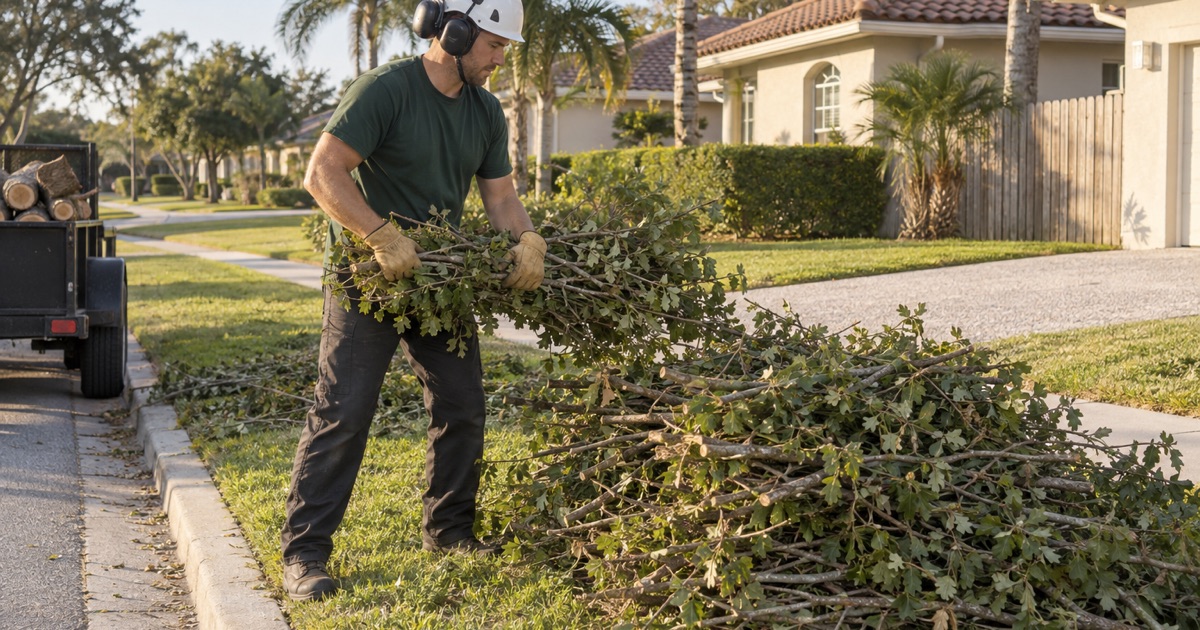
Worker stacking a bundle of cut water oak brushwood in a compact pile inside the line at a Fort Myers verge.

The State Preemption on Single-Family Lots

Florida Statutes section 163.045 bars a local government from requiring notice, application, approval, permit, fee or mitigation to prune, trim or remove a tree on residential property where the owner holds signed documentation that it poses an unacceptable risk. It is the widest opening in Florida tree law and narrower than most homeowners are told, because every condition attached to it is load-bearing.

Unacceptable Risk Is a Defined Standard

The statute’s wording since 2022 is unacceptable risk, assessed against the ISA Best Management Practices Tree Risk Assessment Second Edition 2017 and signed by an ISA-certified arborist or a Florida licensed landscape architect. At least three artifacts in this market still publish the superseded phrase presents a danger, which is materially easier than the law in force.

The Conforming-Use Condition Nobody Quotes

The preemption reaches a single-family detached building on a lot actively used for single-family residential purposes, and that second condition is the one nobody quotes back. A vacant lot, an attached dwelling, a commercial parcel or a house whose use does not conform gets no protection from the statute, and the local code governs everything it leaves behind.

Four Counties, Four Vegetation Permit Regimes

Lee County runs a vegetation removal permit under Land Development Code section 14-411, Charlotte County runs a positive approved tree list and counts points, the City of Punta Gorda runs a separate code inside its own line, and unincorporated Hendry County publishes no tree or land clearing application at all. None of those answers transfers across a line.

Charlotte County Tree Points and Clear Trunk Feet

Charlotte County’s own brochure states that compliance is based on the number of tree points rather than the number of trees, at one point for every two thousand square feet of development site. Its residential materials put the trigger at four inches caliper measured twelve inches from grade and measure palms in feet of clear trunk. Speculative clearing is prohibited outright.

Two Tree Codes Meeting at the Punta Gorda City Line

Inside the City of Punta Gorda the governing document is the city’s own land development regulations and the tree permit costs nothing. Cross into unincorporated Charlotte County and the residential tree permit fee is seventy dollars at application, under a different code written in different units. One address files free under one rule and its neighbor a street away files under another.

LaBelle’s Significant Oak Permit

The City of LaBelle protects significant oaks by name, specifically live oak, laurel oak and water oak, and its code reaches single-family homes on existing lots of record rather than only new development. An approved removal is mitigated inch for inch in replacement live oaks, or at a published one hundred and fifty dollars per DBH inch in lieu.

Mangrove Trimming Is Carved Out Deliberately

Mangroves sit outside the state tree preemption on purpose and are governed by the Mangrove Trimming and Preservation Act, with its own trimming allowances and its own professional mangrove trimmer program. In this ring only the City of Sanibel holds delegated state mangrove authority, so a shoreline tree is a different legal object from a yard tree.

Houses, Common Elements and Rented Lots

Who may authorize the work and who is billed depends on whether the ground under the tree is a fee-simple house lot, an association common element, or a rented lot inside a manufactured home community. This service area holds tens of thousands of mobile homes, and park boards are a buyer nobody’s industries-we-serve page in this ring names.

The Section 163.045 Arborist Letter

The statute asks for signed documentation from an ISA-certified arborist or a licensed landscape architect performed to the ISA Best Management Practices, and that letter is a named product operators in Tampa Bay and Charlotte County sell. Almost nobody in Lee County sells one, and the region’s largest multi-county operator publicly refers those reports out.
Palms, Species and Tree Disease

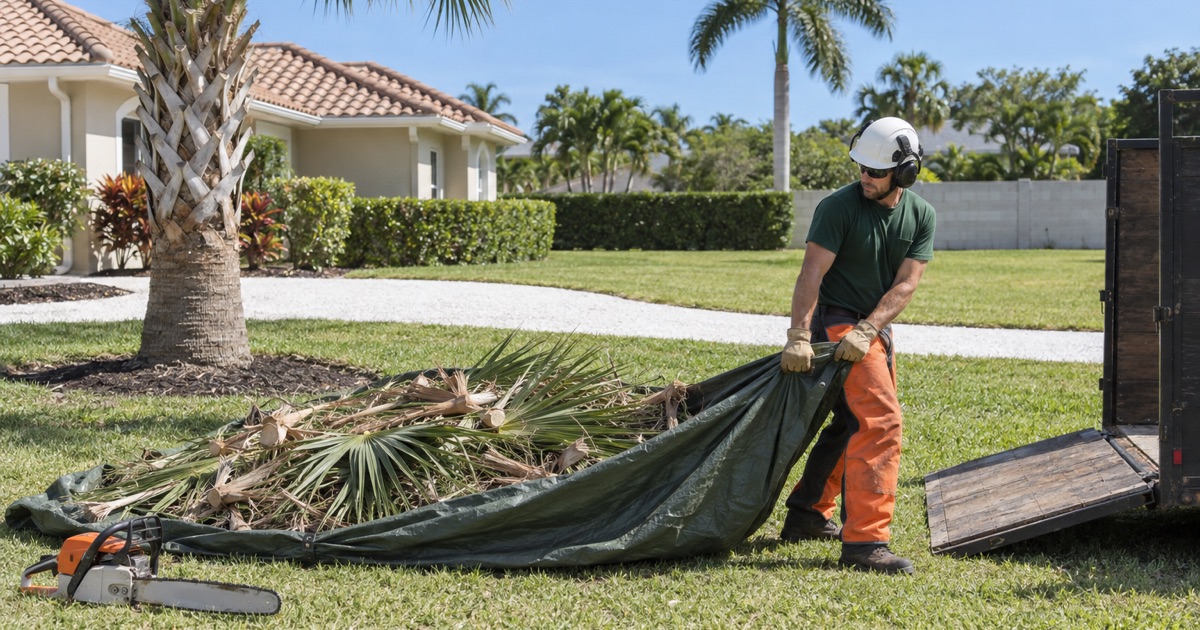
Worker drawing a tarp of cut cabbage palm fronds together in a Fort Myers front yard.

A Palm Is Not a Tree, and the List Is Long

A palm is a monocot, and almost nothing you know about pruning a hardwood carries across to it. There is no branch collar to cut back to, no compartmentalization of decay, no cambium to wound and no lateral growth to replace what is removed. A crew treating a sabal palmetto as a small tree applies the wrong standard from the first cut.

One Growing Point and a Trunk Fixed for Life

Every palm grows from a single apical meristem at the top of the trunk, so damage there is fatal and cannot be pruned around, and the trunk diameter is set for life by conditions when that section was laid down. That is why a palm cannot seal a wound the way an oak does, and why the crown is handled differently from the first lift.

Penciling: the Taper That Never Grows Back

When a palm is stressed by drought, poor nutrition or root damage, the new trunk it produces is narrower than the old and takes on a visible taper the trade calls penciling. Because the trunk never thickens again, that taper is a permanent record of when the stress happened and a structural fact on the tree forever.

Ganoderma Butt Rot and Why There Is No Treatment

Ganoderma zonatum produces a shelf-shaped conk in the lower four or five feet of a palm trunk, and by the time it is visible the internal decay is extensive. No fungicide, treatment or soil amendment changes the outcome, so the honest recommendation is removal and grinding rather than a program of care we could bill for.

Lethal Bronzing and Spear Leaf Collapse

Lethal bronzing is a phytoplasma disease that runs one direction, and a collapsed spear leaf that will not open is one thing to look for alongside premature fruit drop and a bronzing progression through the older fronds. Diagnostic testing through the state laboratory route is the only way to separate it confidently from the other things that brown a palm.

Palmetto Weevil, Invited In by Pruning

The palmetto weevil is the largest weevil in North America and the only major palm killer here that the work itself invites in, because the University of Florida names leaf removal during pruning and transplanting as a primary cause of infestation. It is untreatable once the damage shows, which is a second reason a hurricane cut is malpractice.

Laurel Wilt, and Why Laurel Oak Is Not a Host

Laurel wilt is a beetle-vectored fungal disease of the laurel family, which in this region means redbay, swampbay and avocado rather than oaks. The name trap is worth stating plainly: laurel oak is an oak and is not a host, so a search for laurel oak wilt returns the wrong disease entirely.

Chapter 482 Licenses the Spraying, Not the Sawing

Florida Statutes chapter 482 defines an ornamental to include a tree and makes applying any substance to one, or inspecting it for infestation, pest control, with no carve-out for arborists or tree surgeons. Section 482.1562 separately requires certification to apply commercial fertilizer to an urban landscape, so the plant health half of this trade is licensed while the destructive half is not.

Swamp Cabbage and the Sabal Palm It Kills

Swamp cabbage is the harvested apical bud of a cabbage palm, Florida’s state tree, and because a palm has exactly one growing point, harvesting it kills the palm outright. That is worth knowing before a neighbor offers to take the heart out of a healthy sabal palmetto, and it is the clearest illustration of what one growing point means.

Telling Sabal, Queen, Royal and Mexican Fan Apart

Four palms account for most of the calls here and they are distinguishable from the driveway. Sabal palmetto carries a costapalmate frond and often a boot skirt; royal palm carries a smooth green crownshaft and is self-cleaning; queen palm is pinnate and messy; Mexican fan runs tall and thin. Identification decides the quote before anyone climbs.

Stumps, Roots, Debris and Land Clearing

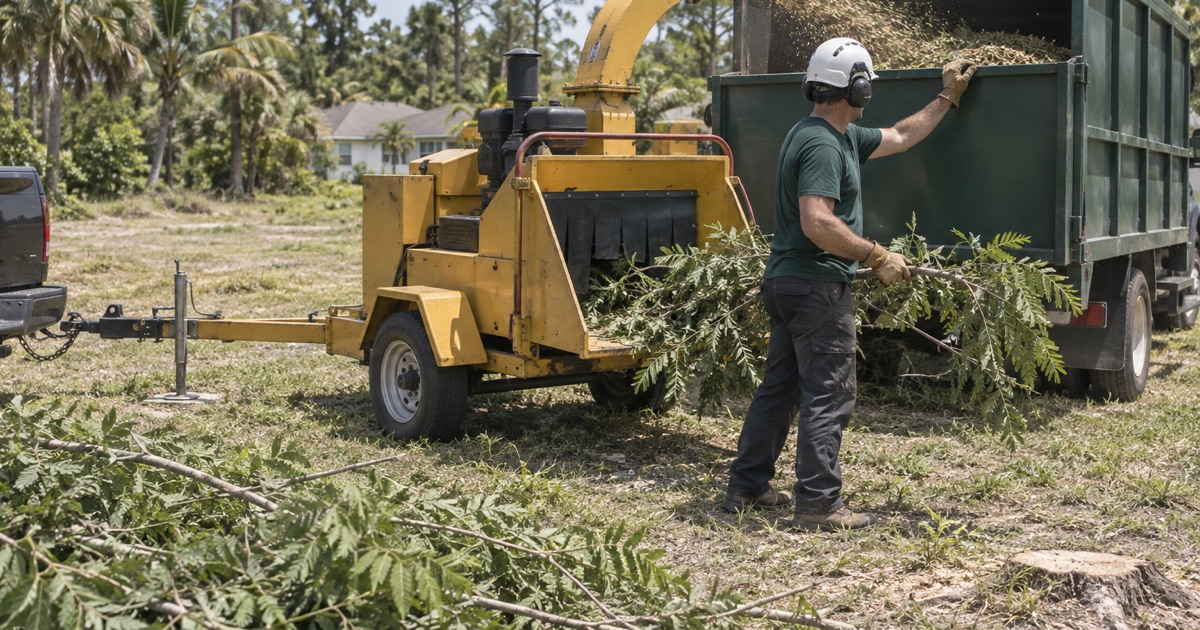
Worker loading cut earleaf acacia brushwood over the chip box rail on a Fort Myers lot.

What a Tree Removal Price Includes

A removal quote here covers dropping or rigging the tree down, cutting it to manageable sections and clearing the work area. Stump grinding, hauling and disposal, backfill of the grinding crater, root work away from the trunk and any permit fee are separate lines with their own numbers, rather than a single figure hiding a stump nobody agreed to.

The Stump, the Grindings, the Crater and Who Fills It

Grinding a stump produces a mound of chips and wood fiber and leaves a depression once the material is removed, and those are three decisions rather than one. Grindings can stay on site as mulch, be raked back into the hole where the grade allows, or go out at the gate rate; clean fill and turf is a fourth line.

Stump Grinder Below-Grade Cut and the Water Table

Rated below-grade cut runs roughly twelve to twenty-five inches depending on the machine, and in this market what stops the wheel most months is water rather than any hard layer. Flatwoods soils here carry a seasonal high water table within six to eighteen inches of the surface for one to four months of most years.

Two Flatwoods Soils, Thirty-Five Inches Apart

The hard layer under these soils is a spodic horizon and its depth varies enormously over short distances. The EauGallie series puts it at about twenty-two inches, squarely inside a grinder’s rated cut; the Punta series, whose type location is in Charlotte County, puts it at fifty-seven to eighty inches, far below anything a grinder reaches.

Surface Roots Under Driveways and in Drain Fields

A root lifting a driveway slab and a root in a septic drain field are different problems with different answers. The slab is usually a question of root collar excavation with an air spade to see what is there before anything is cut, since severing a structural root buys a trip hazard today and a failure later.

Where the Wood Goes and Who Pays the Gate

Wood off a removal goes to a horticultural waste facility, to a chip market or onto the property as mulch, and the three routes cost differently. Fort Myers caps curbside yard waste pieces at four feet long and four inches in diameter, expressly excepting palm fronds, so trunk wood has no curbside route at any volume.

Horticultural Waste Gate Rates by County

Disposal is not one price across this service map. Charlotte County charges a single horticultural waste rate regardless of material and roughly doubles it for loads originating outside the county, so the same truck of the same chips prices differently depending on where the tree grew. We quote the gate that applies to your address.

Hendry County’s Franchise Rule on Hauling

Unincorporated Hendry County treats hauling waste for remuneration or other consideration in any form as a franchise matter under its own ordinance, which reaches the act of carrying the load rather than the act of dumping it. It is one of six distinct refusal shapes across the four counties on this map.

Land and Lot Clearing Is a Separate Permit

Clearing a lot is a different application from removing a tree in more than one jurisdiction here, and the categories are drawn by lot size and location rather than by tree count. Lee County’s single-family clearing category is limited to parcels over five acres, two or more acres on Pine Island, or any lot on a barrier island.

Utility Line Clearing and What It Will Not Remove

Florida Power and Light publishes a three-year cycle on main feeders and six years on neighborhood laterals, uses directional pruning, and removes the debris its own scheduled clearing generates. It also makes trees within ten feet of a line it does not trim the customer’s responsibility, and LCEC does not maintain trees from the service drop. Neither touches storm debris.

Areas We Serve

Fort Myers Tree Removal Pros provides tree-removal throughout the greater Fort Myers area, with the same crews and the same standards on every job.

Good to know

Frequently Asked Questions

What decides the price of a tree removal here?

Four things move a removal price more than height does: how the equipment reaches the tree, whether the drop zone is clear or occupied by a screen cage and a pool deck, what the trunk wood weighs once it is down, and which county gate the debris goes through. We quote access and disposal as their own lines, so you can see which part of the number is the tree and which part is the property.

Do I need a permit to take a tree out of my own yard?

It depends on which of four counties your address sits in, whether the lot is a single-family detached home in active residential use, and what kind of tree it is. Florida Statutes section 163.045 removes the local permit, fee and mitigation requirements on a qualifying lot when the owner holds signed documentation that the tree poses an unacceptable risk. Outside that narrow lane the local code still governs.

Are you licensed?

Florida issues no state license for tree removal, trimming, land clearing or arboriculture, and Florida Statutes section 163.211 preempts local occupational licensing of it. No honest operator here holds a tree contractor license, because there is none to hold. What does exist is ISA certification, the Chapter 482 pest control license covering substances applied to a tree, and verifiable liability and workers' compensation coverage.

Do you haul the wood and the debris away?

Yes, on its own line of the estimate rather than buried in the removal price, because the tipping gate changes price at every county line we cross. Fort Myers collects up to ten cubic yards of yard waste a week from a residence but caps pieces at four feet long and four inches in diameter, so trunk wood has no curbside route at any price.

Can you hurricane-cut my palms before the season?

No, and we refuse it on hardwoods and on palms however the job is asked for. Stripping a palm back to a handful of upright fronds removes the reserves that get it through a storm and opens the wound pattern that draws palmetto weevil. What we will do beforehand is take out dead fronds, seed stalks and genuinely hazardous limbs, with the reasoning put in writing.

How far below grade do you grind a stump?

It depends on the machine we can get to the stump and on what is under it, and in this market the limit is usually water rather than rock. A thirty-five inch grinder that fits down a side yard may be rated to twelve inches below grade or to twenty-five depending on the model, so we state the machine as configured rather than quoting a depth off a brochure.

How fast can you get out after a storm?

We sell hurricane work before the season rather than promising response times during it, because nobody cuts trees in a hundred-knot wind. Once a system passes, the work is triaged by what sits on a structure, what blocks an access route and what is holding tension. The trees that come down two summers later are often the more expensive problem.

Will my insurance pay to take the tree away?

Read the debris removal line on your own policy, because the number is small and it is written per form rather than per state. Citizens Property Insurance publishes Debris Removal for wind-downed trees at five hundred dollars and does not allow it to be increased. One carrier here caps a thousand per occurrence and five hundred per tree, so a third tree pays nothing.

The tree is on the property line. Who pays for it?

Establish where the trunk stands first, because that is what decides ownership, and then establish what the parcel actually is. A house, an association common element and a rented lot in a manufactured home community give three different answers about who may authorize the work and who is billed. We will not cut across a line without the other owner's agreement.

Can a sick tree or palm be treated instead of removed?

Sometimes, and we will say so when it is true, including what pruning or a support cable would cost instead. The answer on palms is narrower: Ganoderma butt rot has no treatment once the conk forms, lethal bronzing runs one direction, and palmetto weevil is untreatable by the time you can see it. Applying anything to a tree here is licensed pest control.

Ready to Get Started?

Request a free quote today and we'll get back to you fast.