Fort Myers Tree Removal Pros takes tree disease treatment and plant health care calls throughout Fort Myers, FL and the surrounding cities on our map, including North Fort Myers, Cypress Lake, Cape Coral, Florida Gulf Coast University and Lehigh Acres. After twenty-plus years the honest description of this service is that half of it is diagnosis, a good part of it is cultural correction, and a meaningful share of it is telling somebody there is nothing to buy.
This trade is regulated in a way that surprises most people, and in the opposite direction from what they assume. Florida licenses nobody to cut a tree down, but applying any substance to one is pest control under Chapter 482, which defines an ornamental to include a tree and provides no exemption for arborists or landscapers. The destructive half is unregulated and the plant health half is licensed.
So this page is about what is actually wrong with the tree in front of us, what the local diagnoses genuinely are, and which route addresses the cause. Several of the most common palm findings here have no treatment at any price, and saying so plainly is more useful than a program of care that changes nothing.
Diagnosis First, Because Several Answers Are Terminal
The Palm Diseases With No Treatment
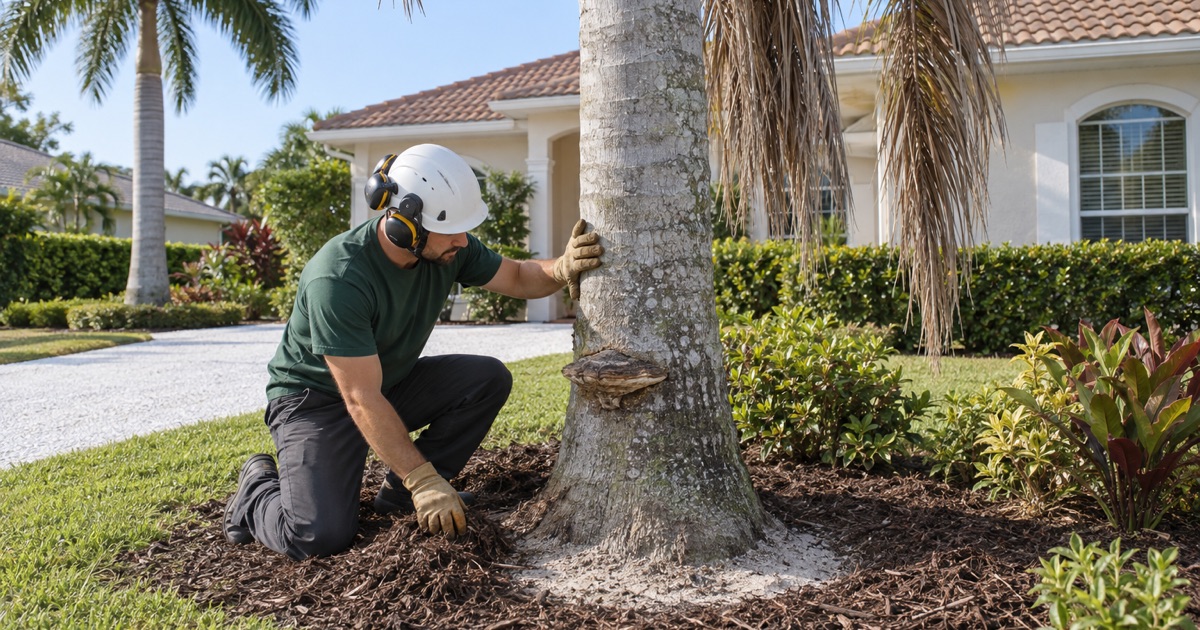
Three of the primary palm killers in this market cannot be treated once they are visible. Ganoderma butt rot announces itself with a hard shelf-shaped conk low on the trunk and mandates removal and grinding. Lethal bronzing runs one direction. Palmetto weevil, the largest weevil in North America, is untreatable by the time the crown shows the damage, and pruning is itself a primary cause of infestation.
What Testing Exists, and What It Settles
Several palm problems look alike from the driveway, which is why symptoms alone are a poor basis for spending money. Diagnostic testing through the state laboratory route is what separates a phytoplasma disease from a manganese or potassium deficiency that looks similar in the crown. We will tell you when a sample is worth taking and when the pattern in front of us already answers the question.
Deficiency and Water Stress, Which Are Correctable
A large share of what gets called disease here is nutritional or hydrological. Palms in sandy soil on aggressive irrigation lose nutrients readily, and the deficiency patterns show in predictable places in the crown. Those cases respond to a corrected program, which is a genuinely different conversation from the terminal diagnoses above and deserves to be separated from them on the estimate.
Plant Health Care Without Reaching for a Sprayer
Root Collar Excavation and Soil Decompaction
The most consequential problems on mature trees here sit below grade where nothing is visible. Excavating the root collar with an air spade exposes a buried flare, a girdling root or decay at the buttress without severing anything, and decompacting a root zone that has been parked on or driven over restores the pore space roots need. Both address a cause rather than a symptom.
Mulch, Irrigation and the Things That Actually Kill Trees
Soil or mulch piled against a trunk keeps the bark wet and invites decay at exactly the point the tree cannot afford it. Grade raised over a root plate during construction suffocates roots slowly. Irrigation running daily on a mature tree that needed none encourages a shallow root system in ground that already floods. None of these is a pathogen and all of them are fixable.
Pruning as a Disease Response
Where infected, dead or structurally failing material is part of the problem, removing it properly is the treatment. That means clean reduction and removal cuts to the correct position, sanitation between trees where a pathogen is in play, and no topping under any circumstances, because a topped tree responds with weak regrowth on a stem that is already decaying inward.
The Regulated Half of This Trade
Chapter 482 and What Counts as Pest Control
The statute’s definition is broader than most homeowners and a fair number of contractors realize. It makes applying a substance to an ornamental, and inspecting an ornamental for infestation, pest control, and there is no exemption written into it for tree work. That is worth knowing when a company offers to inject or drench something on the day it quotes a trim.
Fertilizer, Certification and Local Rules
A separate section requires certification to apply commercial fertilizer to an urban landscape, and the state’s Green Industries Best Management Practices program is the framework behind much of that training. Several local governments in this region add their own seasonal restrictions on top. We will tell you which of those apply to your property rather than presenting a feeding program as if it were unregulated.
- 20+ Years on This Coast
- Written Condition Reports
- Four Counties Covered